

I have worked with revision control and on revision control systems for quite some time now and I had every opportunity to develop strong opinions. Many of those opinions have changed as parallel LLM development became the norm. Tomorrow, the process will likely evolve even further. So, how do I see modern revision control? Can I really have any stable opinion here?
The only stable thing now is constant change. How can source code management help here? Should we use worktrees, patch stacks, CRDT merges, trunk-based development? The correct answer is that I do not know what will work tomorrow. So the revision control system must, first and foremost, be adaptable to any new process, including project-specific processes.
Beagle, the revision control system, is built to fit
this exact condition. There is libdog, the layer of fast
and deterministic tools of the trade: git compatibility, source code
tokenization, indexing, data exchange format, diff and merge
algorithms. There is a minimalistic JavaScriptCore-based JS
runtime JAB. I do not use node.js and others because of
their weight and ridiculous supply chain issues. Finally, on
top of JAB there is the malleable part - the revision control
system itself. Beagle is made in a very specific way -
it uses an orthogonal basis of HTTP verbs (GET, HEAD, POST,
PUT, PATCH, DELETE) to do any work and URIs to address any
resource. The runtime itself can execute any "verb", so diff,
status, list, log and many other normally expected
things are there. In fact, I write it as I go. I need a tool,
I tell Claude to make a tool.
So the stack is like this:
Changes to libabc I carefully read, changes to libdog I
look at, beagle I can vibe. This way I keep the actual
behavior malleable without devolving the codebase into
slop. Frankly, Netscape invented JavaScript exactly for
this kind of use.
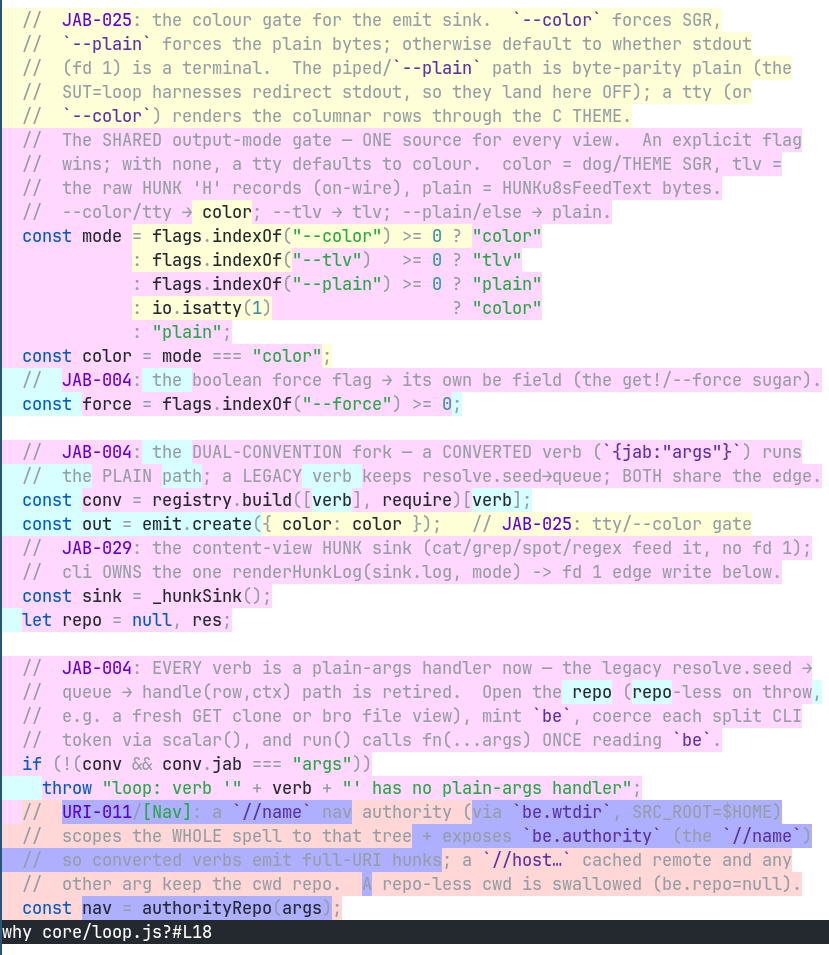
Yesterday I wanted a new blame view. It took me a couple of
hours, and I called it why. Because, when you work with LLMs,
you can only blame yourself! It is all JavaScript, all the
heavy lifting is done by the libdog backend, and it works.
If I do not like how it works, I can tell Claude to correct
things. JavaScript is sufficiently safe and malleable to
make this process painless. In fact, that became the norm:
I have a terminal to work on a thing and another terminal
on the side to work the tool to work the thing.
Beagle likes dogfood!